Ladies and gentlemen, the committee has gathered today to discuss “spypunk.”
“Spypunk,” if you will, has flown under the radar for some time. This clandestine ring of books, movies, and TV shows is running a massive influence operation inside our heads. While it’s not my intention to expose the existence of spypunk to the public at large, I do intend to reveal to you, the committee, just how pervasive the influence of this secret genre is. Then, perhaps, we can decide what to tell the American people.
Before we get to the individual assets (novels, TV shows, etc.) working within this insidious network, we’d better define our term.
What is spypunk?
Spypunk is espionage fiction that uses speculative elements not as mere window dressing but as integral components of plot, character, and worldbuilding. The espionage element may be central or complimentary to the main story. The setting may be historical, invented, or some mix of the two.
Ultimately, a sense of menace or terror should hang over most pages. If grandma’s going to have a cup of magical tea, she’d better be doing it in a safehouse. 😉
Here are the novels, movies, and TV shows that my sources have identified as agents of spypunk.
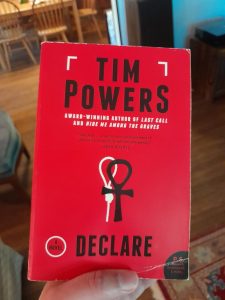
 Declare – Tim Powers
 Declare – Tim Powers
This is the OG spypunk novel.
It’s a powerhouse concoction of historical fiction, conspiracy theory, and supernatural terror.
In a nutshell, Kim Philby was a real British spy who defected to the USSR during the Cold war. While Philby’s story looks simple enough in a Wikipedia summary, a deeper dive reveals many strange details that defy easy explanation.
Powers takes these unanswered questions and weaves them into a shocking story that leans into horror as well as fantasy. We’ve got an ancient conspiracy, demonic djinn, and an explanation for Soviet atrocities that makes far too much sense.
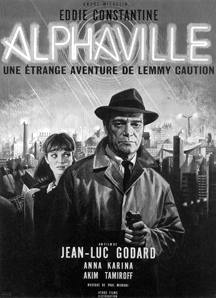
 Alphaville – Jean-Luc Godard
 Alphaville – Jean-Luc Godard
This surreal French film gives Declare a run for its money in terms of who’s the actual OG of spypunk. While the movie predates Declare by decades, the espionage worldbuilding isn’t fully developed. It’s used as a device to create a sense of dystopia (the primary material of the story) rather than being the primary material of the story. For that reason, I would consider it slightly less spypunk than Declare.
But don’t get me wrong—it’s one heck of a film. We’ve got secret agents, a sentient computer with a gravelly voice, ubiquitous psyops, and all kinds of fun stuff.
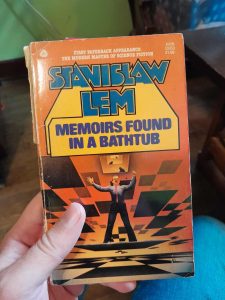
Memoirs Found in a Bathtub – Stanislaw Lem
 Memoirs Found in a Bathtub – Stanislaw Lem
Lem is a writer with serious range.
He excels at hard science fiction, with masterpieces like Solaris, His Master’s Voice, and Tales of Pirx the Pilot I and II. Reading Lem’s hard stuff will make you realize what science fiction is supposed to be—and it’ll have you categorizing Star Wars as a space fantasy, not science fiction.
For me, though, Lem’s most intriguing work is this one.
It’s a farce, a spy satire, a surreal fable, and a Soviet dig on the United States all in one—thoroughly Cold War, thoroughly bizarre, and entertaining to the last page.
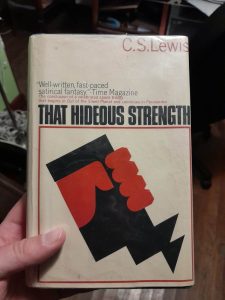
That Hideous Strength – C. S. Lewis
 That Hideous Strength – C. S. Lewis
What’s that, you say?
C. S. Lewis wrote spypunk?
While That Hideous Strength is primarily a fantasy thriller, there is an espionage element woven in. We’ve got forces of good and evil gearing up to battle for the soul of England—and they’re doing it under cover. The good guys are truly clandestine, while the bad buys use a government-funded project as the façade of their operation.
Blown cover means torture or death for the good guys, and there’s all kinds of supernatural stuff going on, so this one fits nicely in the spypunk category.
 My book that’s on publishers’ desks right now
 My book that’s on publishers’ desks right now
My own novel, currently under consideration at major fantasy publishers, is a spypunk operator, revealed here for the first time. (Hint: That’s why I came up with this term. If your book doesn’t fit into a genre, invent one!)
This novel is on an assignment so dark and devious, I am not at liberty to disclose the title, the pitch, nor any differentiating characteristics to you, the committee. You’ll have to take my word for it and await that book deal announcement. In the meantime, I can give you a few general specifics, as they say.
- It’s set during the Cold War in another dimension.
- It features themes like loss of identity, found family, ideology, extremism vs. western liberalism, and our search for meaning.
- There are no easy answers, as people with wildly different concepts of identity search for wholeness in the midst of cultural warfare.
 Here and Now and Then – Mike Chen
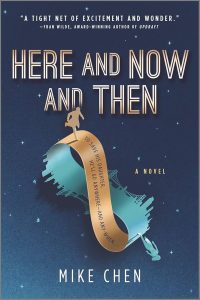 Here and Now and Then – Mike Chen
It’s rare to find espionage fiction that’s heartwarming.
More often, these stories are heartbreaking.
Someone doesn’t make it over the Berlin Wall. A true friend turns out to be a double agent. You know the drill.
Here and Now and Then is different. We’ve got a time-traveling secret agent who gets stuck in one timeline, has a family—and then gets rescued. Now he has to try and raise his daughter across this massive divide in time.
The only other spy fiction I can think of with a family angle is Len Deighton’s Bernhard Sampson novels, but if you know those books, you know that family scenario isn’t exactly heartwarming.
Here and Now and Then is a refreshingly unique book—highly recommended.
Severance – Apple TV
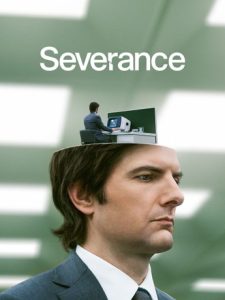 Severance – Apple TV
Is Severance really spypunk?
I think so. We’re looking at corporate espionage. Both the clandestine nature of Lumon Industries’ work and the concept of severed memory set us up for spypunk right away. We’ve got secrecy, information that’s hidden from characters within their own heads, and operators working both sides of an ontology-defining information divide. The mood is seriously dystopian and emotionally brutal, both hallmarks of good spy fiction.
In a sense, though, Severance might be the most unique spypunk story out there. Not only are outsiders trying to figure out what’s going on inside the Lumon complex—so are the employees who do the actual work.
Of course, the series touches other genres, like horror and Lynchian surrealism—but these admixtures only make it better.
End of testimony
There you have it. Spypunk is operating all around us, inside our heads, making us yearn for bizarro thrillers with weird speculative elements. One day, we will have to unseal these documents before the American public.
Until then, we need a good cover story.
So don’t blow spypunk’s cover.
Whatever you do, don’t tell anyone about it. Just go on enjoying it.
P. S.: Did I miss anything? Are there more novels and shows and movies to add to the spypunk canon? Leave a comment below, and let’s build a better picture of this genre.
About Leo Vaughn
 Leo Vaughn writes unusual fantasy for unusual people. His work is represented by Lucienne Diver of the Knight Agency.
Want updates?
Sign up for Leo's email newsletter.